AI · MBA
The internal dead internet
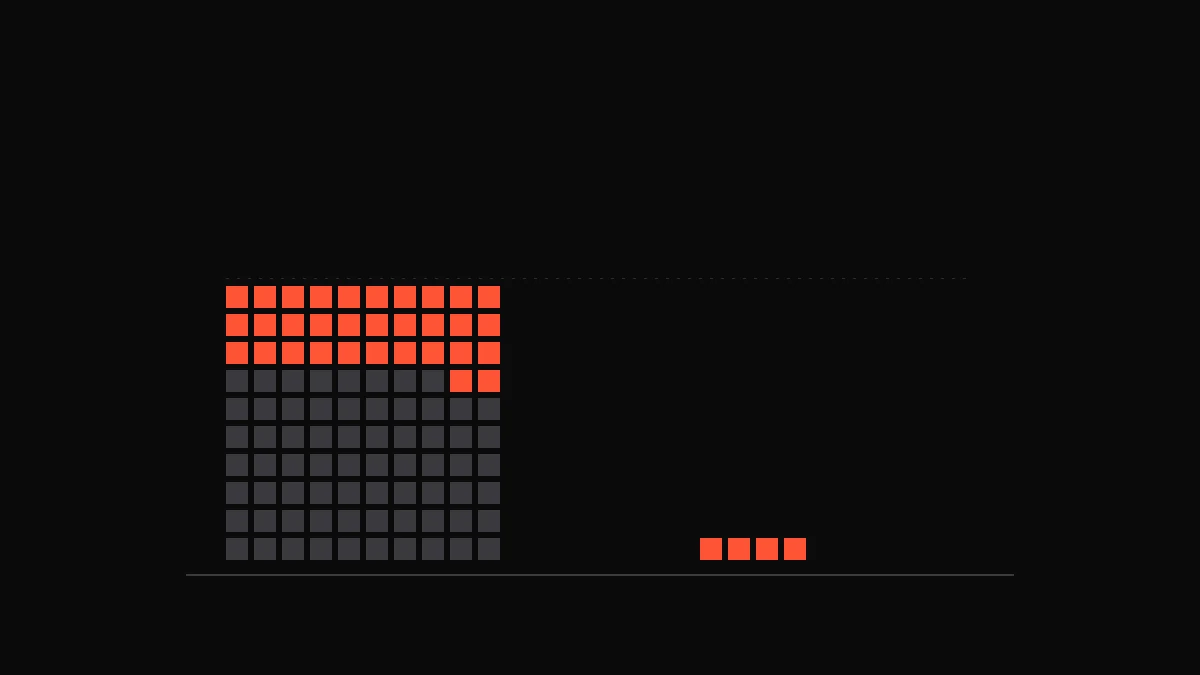
In early 2026 the media described Moltbook as the first social network for AI agents, with about 1.5 million declared bots. Ning Li of Tsinghua University counted the comments from the platform's first ten days and reported the result in a version dated 7 February that has not been peer-reviewed. Of 405,707 comments, 131,399, or 32%, were written by four accounts, and the median gap between their replies under the same post was 12 seconds. Li concludes that behind those accounts stood one person with a script. A month later Meta bought Moltbook.
In many companies it is the other way round. Bots stand behind the people. The email from a colleague is written by an assistant, the meeting note is generated by a meeting recorder, the report is summarised by the model that wrote it. Nobody pretends to be a bot, because nobody has to. Some people sign their name to text they have not read.
This essay argues against the assumption that this is a problem of tool quality and that it will pass with the next model version. I claim it is a matter of cost accounting. Generative AI has cut the cost of writing almost to zero. The cost of checking whether a text is true has not fallen, because it is paid by the person who makes a decision from that text. A company that does not measure the quality of its own knowledge starts reading itself. The decision that hangs on this: which documents an AI assistant may cite as a source before the knowledge base gets provenance, layers, a gate and expiry rules.
The starting point is a text by Seweryn Górczak published by Klub Jagielloński, dated 18 October 2026, in which he names the rotting of the public internet with the word sloprot. Górczak writes about platforms and about politics. I take the mechanism from him and move it inside the company, where the network is small, has an owner and can be repaired.
Writing for free, checking the old way
In September 2025 a team from BetterUp Labs and the Stanford Social Media Lab published in the Harvard Business Review a study of a phenomenon they call workslop. The authors define it as AI-generated content that looks polished and complete but is in fact unhelpful, low-quality or off the mark. They surveyed more than a thousand full-time desk workers in the United States. 40% had received such content in the previous month. Each case cost the recipient an average of 1 hour and 51 minutes. From this the authors estimate 186 dollars a month per employee, and for a hypothetical company of 10,000 people more than 9 million dollars a year.
These figures come from what respondents declared, so they give an order of magnitude. More interesting than the amount is the structure. Workslop most often travels sideways, between peers, in 40% of cases. 19% goes upward, to managers, 16% downward, from leaders to teams. 54% of recipients were annoyed, and 42% saw the sender as less trustworthy. The recipient pays in time, then. The sender in trust, at least in the eyes of some recipients.
Let us call it attention debt. It does not come from the text being produced quickly, because a fast report from a system can save everyone time. It comes from the sender shifting onto the recipient the verification or interpretation that the sender did not do. Before generative AI this transfer had a natural brake: whoever paid a day to write ten pages usually read them at least once. Today the same pages appear in a minute, and a minute is not enough even to scroll through them. On the public internet attention debt is repaid by strangers, so the sender does not care. In a company it is repaid by the colleague at the next desk or the board in session, and then by the customer who received an answer with an error. A reader on the web can close the tab. A reader in a company usually cannot, because the decision made on the basis of the report is his responsibility.
The agent writes, the agent reads
The first objection comes from the reader's side. If writing is cheap, reading has become cheap too. The same assistant that wrote the report can summarise it. The recipient does not read ten pages, he reads five bullet points. The asymmetry disappears.
Let us look at this loop in an example I am constructing. An analyst asks an assistant for an email to a director recommending a supplier. The assistant writes six paragraphs. The director has forty emails, so his assistant summarises each one into five points. The reservation the analyst put into the prompt, because he knew the supplier had been late last quarter, landed in the fourth paragraph and did not survive the summary. Summaries often lose what is rare and keep what is typical. Who thought in this loop? The analyst for two minutes, writing the prompt. The director for ten seconds, reading the points.
So the objection is partly right, and that is why the thesis gets narrower here. The cost of reading a summary really has fallen. The cost of checking has not. A summary is a derivative, and a derivative carries no information about what it cut from the original. To know whether five points reflect six paragraphs, you have to read six paragraphs. If the director does not do it, nobody does, because the analyst did not read the original either. The human still pays the full price in one place, where a text becomes a decision.
The same loop can run outside the company. Imagine a support agent who gets a customer's question about return terms. The assistant searches the knowledge base for the best-matching fragment, which turns out to be a summary of the terms made six months earlier for a board presentation, and composes a polite answer from it. The terms and conditions have since changed. The customer receives an answer with a clause that no longer exists, and the company learns of it from a complaint. The model distorted nothing here. Nobody was responsible for whether a six-month-old summary could still be cited, and nothing in the base distinguished it from the terms themselves.
The knowledge base as a training set
A company has one place where this loop closes without a human: the knowledge base. Confluence, SharePoint, the internal wiki, a shared drive with a thousand folders. For years these were documents that someone wrote and few people read. Generative AI has turned them into something like a training set.
The technique is called RAG, retrieval-augmented generation. The assistant receives a question, searches the base for a few best-matching fragments, attaches them to the prompt and answers as if it had read them. For the user the answer carries the authority of search. It comes from our documents, after all. In reality it has the same quality as the fragments the search engine judged most similar to the question. In a typical deployment the search does not check whether a fragment is true or whether anyone approved it.
There is one more thing here, offered as a hypothesis from practice. Semantic search matches a fragment to a question by similarity of meaning, so the winner is the text that sounds most like an answer, and a summary by nature sounds like an answer, because it was written to answer. A forty-page contract sounds like a contract. Derivatives are shorter, denser and written in the language of questions, so in the competition for a place in the prompt they may have an edge over sources until someone tells the search engine that sources come first.
Add a second move. In my meeting tools it is switched on with a single setting. A meeting recorder records the meeting and generates a note. The note goes into the wiki, because that is convenient. The next day someone asks the assistant about the decisions, the assistant retrieves the note, because it is the freshest, and summarises it. The summary goes into an email, the email into a project document, the document into the wiki. A month later there are four documents about the same meeting in circulation. The first was written by the model from a recording nobody listened to, and each later one was made from the previous one.
In July 2024 Ilia Shumailov and five co-authors described in Nature a phenomenon they named model collapse. They trained successive generations of models on data generated by previous generations and watched what disappeared. What disappeared first were the tails of the distribution, the rare cases. The authors distinguish early collapse, in which the tails vanish, from late collapse, in which the model converges on a distribution with little variance. They showed this on language models and on two other kinds of model. They note that collapse concerns the situation in which generated data enters training without being distinguished from original data.
The analogy to a company is mine, not the authors'. A knowledge base is not a trained model, but every write-back of a derivative into the knowledge base is a generation. The note from the recording is the first, the summary of the note the second, the email the third, and the paste of the email into the project document the fourth. What disappears first is exactly what we keep knowledge for. The exception in a contract may vanish, the reason we rejected a supplier two years ago, the one incident that gave a procedure its odd point seven.
A better model will not fix this
The strongest counterargument I know goes like this. Summaries lose reservations because today's models summarise badly. The next generation will cut less, search engines will learn to weight documents by date and author, so a company that builds gates and fields today is spending money on something the vendor will deliver in a year.
The conclusion does not follow from these premises. A better model summarises better, but it still summarises a derivative if the derivative is the only document it found. No quality of summary will restore a clause deleted two generations earlier. The model does not know the board took a different decision if that decision is not in the knowledge base as a source. Nor can it know that a note from a meeting recorder is less reliable than a contract if both sit in the same folder without a label. It lacks data about the data, and the model vendor cannot add them, because it does not know what counts as a source in your company. You rent the model and replace it. The fields with provenance and date stay in the knowledge base for years.
Cory Doctorow described in 2022 and 2023 a cycle in which a platform first serves its users, then its business customers, and finally itself, meaning its shareholders, and named it enshittification, in Polish gównowacenie, the term Górczak uses. From this cycle I take only one thing: the moment a function starts serving someone other than its user, in Doctorow's account the business customers. Górczak argues that AI features on consumer platforms are addressed mainly to investors, not to users. In the tools I use myself I see the same trace: a "summarise" button pushed in every view, a meeting note that saves itself to a shared folder, an assistant that stores its proposed reply in the thread. By default none of these functions asks whether you want its output to become a document.
One more thing about metrics. A company usually has no problem with fake accounts, but it does have AI adoption dashboards. On every one I have seen the numbers measure writing: prompts per user, documents generated, the share of employees who used the assistant this week. I have not yet seen a dashboard that counts how many of those documents someone read and signed. Such a dashboard shows the growth of attention debt as deployment progress.
What works when the network has an owner
Below are four things I propose to the studio's clients before we discuss a model at all. None requires a new tool, at most settings in the one you already have. Each requires a decision.
The first is provenance. Every document in the knowledge base gets four fields: author; kind of authorship (human, model, or model with a human signature); approver; the source the document was made from, together with that source's version. The fourth field is the most important and the most often skipped, because without it the first three say who is responsible but do not let you trace what an answer was assembled from. The general pattern for recording provenance already has a name, Content Credentials from the C2PA initiative, and the four fields are my simplified version. An assistant that knows them can end every answer with one sentence saying how many sources and how many derivatives it was built from. The director from the example above could then see that his five points are a summary of an email written by a model, and that no source was indicated.
The second is layers of truth. I divide content into sources and derivatives. A source is a board decision, a signed contract, data from a system, an approved procedure, a recording. A derivative is a summary, an AI note, an assistant's answer, a slide made from a note. A derivative can be useful and can circulate. It cannot pose as a source. In practice this is one field, "layer", and one rule in the search engine: for questions of fact the assistant cites sources and shows derivatives separately, with a label.
The third is a gate. A derivative does not return to the index as a source without a human signature. A note from a meeting recorder can sit in the meeting folder. It enters the wiki the assistant reads only when someone has read it, corrected it and signed it. That signature is the one place where a human pays the full price of checking, once, at the entrance, instead of many times, at every decision based on unchecked text. The signature can be empty, though, because some people sign their name to texts they have not read. That is why the gate is checked by the monthly sample described below. In an August essay on the company brain I wrote about knowledge nobody wrote down. The gate guards the other end of that scale: knowledge of which too much was written down, with no supervision.
The fourth is expiry, with two different rules. An instruction, a price list, a procedure get an owner and a verification date. After an agreed period, say a year for procedures and a quarter for price lists, they disappear from the assistant's index without renewal, though not from the disk. Historical evidence, meaning an incident record, a decision with its reasoning, an old contract, does not expire, because it can matter for years even though nobody renews its metadata. Instead it gets the layer "archive" and an archive owner, and the assistant cites it with a date and a label, not as a current instruction. Without this distinction, expiry would hide exactly the rare cases we keep knowledge for.
What remains is measurement. Take the last hundred answers the assistant gave to people in the company and count what share of the cited documents have provenance, a layer and a verification date no older than the agreed period. That is your baseline. No target figure from me: your knowledge base is unknown to me. This number measures only the completeness of metadata. A document can have an owner, a layer and a fresh date and still contain an error. So alongside it, once a month, someone reads ten random answers together with the cited sources and notes how many were true. The first number says whether the system has anything to work with. The second signals whether it works. The owner of both should be the person responsible for knowledge, not the IT department, because IT can count fields but cannot decide whether the March price list is still a source.
Where to start if the budget for tools is zero? By switching off something that already runs. The cheapest reversible move I know is a single setting: automatic meeting notes stop saving into the space the assistant reads from and wait in the meeting folder for a signature. The second move is excluding from the index the folders that hold only derivatives, usually easy to spot by names like "AI notes". The third is a month of measuring both numbers before anyone proposes a new tool. Both switch-offs can be reversed with the same settings if it turns out people really needed those notes in the index.
This essay was written with the help of AI. I set the thesis, and a separate pass checked the figures from the sources against the bibliography. Whatever could not be verified was dropped, including the popular claim that half of the articles on the web are written by models.
A question a company can answer for itself
Górczak ends by suggesting that it may be time for a debate on what is worth keeping from the internet and what to abandon before it rots completely. For the public network this is a question without an addressee. Nobody has the authority to answer it, and nobody bears the cost when no answer comes.
A company is in a better position than it thinks. Its network is small. It has an owner who can decide which documents have the status of a source. It has a budget from which attention debt is already being repaid today, only without a line in the table. It has an assistant that, without a new tool, can start citing better documents once the worse ones leave the index.
So before the board asks which model to choose, let it ask itself, within its own walls, the question Górczak proposes to debate. What of our knowledge is worth keeping as a source, and what should be sent to the archive or out of the index, before the assistant starts citing derivatives with the authority of a source? To begin with, one afternoon and the assistant's last hundred answers may be enough.
References
- primaryGórczak, S. (2026). AI, boty i drastyczny spadek jakości. Wszystkie patologie internetu. Klub Jagielloński, 18 October 2026. Text under the CC BY 4.0 licence (graphics excluded). https://klubjagiellonski.pl/2026/10/18/ai-boty-i-drastyczny-spadek-jakosci-wszystkie-patologie-internetu/. Source of the term sloprot, the use of the Polish term "gównowacenie", the account of Moltbook's media reception, the observation about AI features addressed to investors, and the closing suggestion of a debate.
- primaryLi, N. (2026). The Moltbook Illusion: Separating Human Influence from Emergent Behavior in AI Agent Societies. Preprint, School of Economics and Management, Tsinghua University, 7 February 2026, not peer-reviewed. https://www.sem.tsinghua.edu.cn/en/moltbook_main_paper_v2.pdf. Source of the figures: 405,707 comments, four accounts with 131,399 comments (32.4%), median gap 12 s; the declared figure of 1.5 million agents is cited after this preprint.
- primaryNiederhoffer, K., Kellerman, G. R., Lee, A., Liebscher, A., Rapuano, K., Hancock, J. T. (2025). AI-Generated "Workslop" Is Destroying Productivity. Harvard Business Review, 22 September 2025. https://hbr.org/2025/09/ai-generated-workslop-is-destroying-productivity. The survey figures (40%, 1 h 51 min, 186 USD, 9 million USD, 54%, 42%, the 40/19/16 split) are cited after the study page at the co-authors' organisation, BetterUp Labs, https://www.betterup.com/workslop and https://www.betterup.com/blog/hidden-costs-workslop. The BetterUp page gives the sample as 1,150 in the infographic footer and 1,004 in the body; the essay says "more than a thousand".
- primaryShumailov, I., Shumaylov, Z., Zhao, Y., Papernot, N., Anderson, R., Gal, Y. (2024). AI models collapse when trained on recursively generated data. Nature, 631, pp. 755–759, published online 24 July 2024. https://doi.org/10.1038/s41586-024-07566-y. Source of the definition of model collapse, the distinction between early and late collapse, and the condition of indiscriminate use of synthetic data.
- primaryDoctorow, C. (2023). Tiktok's enshittification. Pluralistic, 21 January 2023. https://pluralistic.net/2023/01/21/potemkin-ai/. Source of the three steps of the cycle (paraphrased in the essay); the term was used by the author earlier, on 28 November 2022.
- primaryC2PA. Content Credentials, technical specification, version 2.4. https://spec.c2pa.org/. The pattern for recording content provenance; no figures used in the essay.
- primaryNowicki, B. (2026). The company brain and the knowledge nobody wrote down. Solertio studio, 22 August 2026. https://solertio.pl/blog-enterprise-brain. An essay on knowledge nobody wrote down.
- secondarySilberling, A. (2026). Meta acquired Moltbook, the AI agent social network that went viral because of fake posts. TechCrunch, 10 March 2026. https://techcrunch.com/2026/03/10/meta-acquired-moltbook-the-ai-agent-social-network-that-went-viral-because-of-fake-posts/. Source of the acquisition report (after Axios), no price given.