MBA · ∩
Mimetic desire: why you want what others want
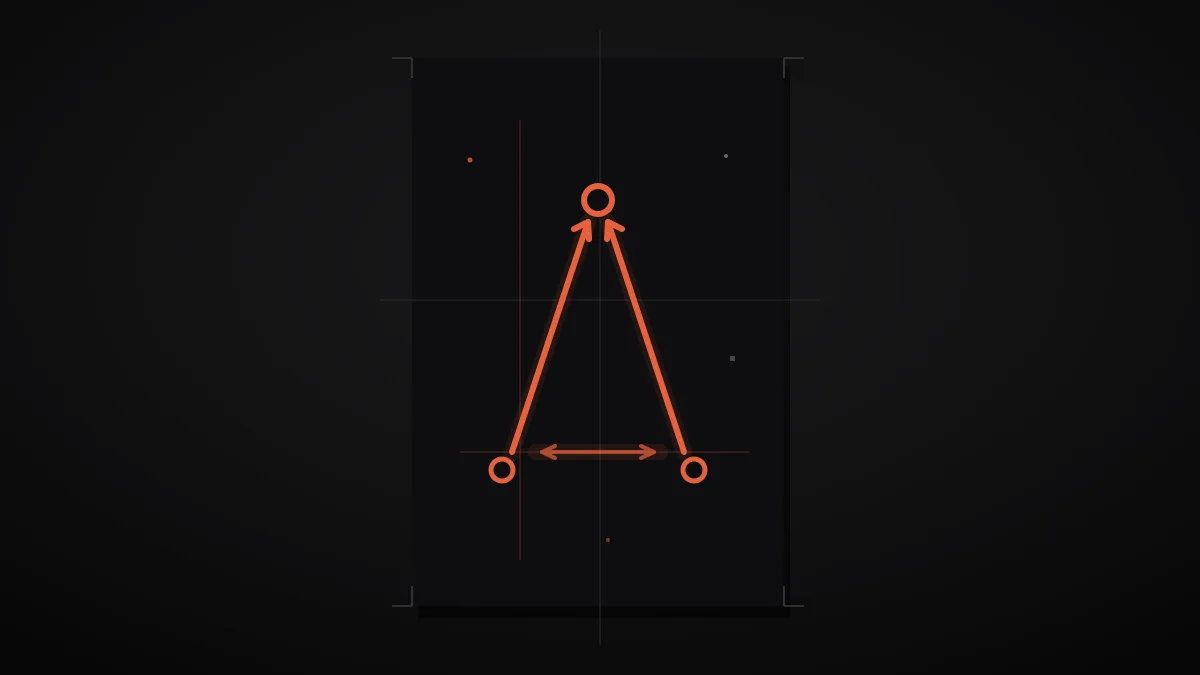
Most goals feel self-authored. René Girard spent a career arguing they are not: we want things because other people want them first, and the wanting arrives before any audit of value. That is a live risk when you allocate years of a career or a roadmap, because a borrowed objective function compounds like any other unexamined input. Girard's triangle — subject, model, object — is the cheapest audit tool I know, and it pays most before the commitment, while a change of mind still costs nothing.
A theory from five novels
Girard was a French literary critic who spent his working life at American universities, the last decades at Stanford. In 1961 he published Mensonge romantique et vérité romanesque — in English, Deceit, Desire, and the Novel. The method was odd for a theory of human motivation. He read five novelists closely and claimed they had all discovered the same thing. Cervantes, Stendhal, Flaubert, Proust, Dostoevsky: in each of them, desire never runs in a straight line from a person to a thing. It passes through a third position — someone who wants the thing first, or seems to.
Don Quixote does not desire adventures directly. He desires them because Amadis of Gaul, the perfect knight of his books, desired them; he outsources his wanting to a fiction and follows it into windmills. Emma Bovary wants the life her romance novels taught her to want. Proust's narrator wants entry to the Guermantes salon because the people he admires treat it as the summit of the world. The structure is constant: a subject, a model, an object. Girard called the model a mediator, and desire that flows through one — mediated, or mimetic, desire.
Dostoevsky gave him the extreme case. In The Eternal Husband, a widower seeks out his late wife's lover and parades his new fiancée in front of him. He cannot marry a woman until this man — his humiliator — has certified her as desirable. The example sounds pathological. Girard's claim is that it is ordinary desire with the disguise removed: the model generates the wanting outright.
The provocation is in what the triangle denies. We tell ourselves desire is spontaneous: I saw the thing, the thing had qualities, I wanted it. Girard names that story the romantic lie. The novelistic truth, in his reading, is the triangle — and the great novelists are great precisely because they stopped believing the lie about their own characters. It is honest to add that this was literary criticism. Girard generalized from a shelf of geniuses to a claim about the species, and whether that induction holds is a fair question. I return to it at the end.
Why trust novelists over psychologists on this? Girard's answer sits in the endings. The great novels close with a renunciation. Don Quixote recants chivalry on his deathbed, Julien Sorel drops his ambitions in prison, and Proust's narrator sees the salon world as wasted time redeemed only by writing. Girard read those endings as the author's own confession — the novelist caught himself desiring through mediators, and the book records the recovery. A romantic work flatters the reader's belief in spontaneous desire. The novelistic work dismantles that belief from the inside. The same test still sorts business books, which as a genre flatter like romances.
One more piece of the 1961 book matters here. Girard noticed that the object tends to shrink as the drama unfolds, while the model grows. The lover cares less about the woman than about the rival; the snob cares less about the salon than about the person who belongs there. His conclusion: desire aims past the object, at the model's way of being. He called this metaphysical desire. What the subject finally wants is to be someone else, and the object is the ticket. Eleven years later, in Violence and the Sacred (1972), he took the triangle out of literature and into anthropology — and the stakes moved from unhappy lovers to ritual killing. Michel Serres would later call him the Darwin of the human sciences; the Académie française elected him in 2005. The reception matters less than the mechanism, so let us take the mechanism apart.
From imitation to rivalry: the mechanism
Start from first principles instead of Girard's authority. Imitation is the cheapest learning algorithm a social species has. A child who copies what adults value skips a generation of trial and error about what is safe to eat and useful to keep. Copying actions is cheap; copying preferences is cheaper still, because a preference compresses thousands of future decisions into one setting. Evolution had no reason to make that circuit ask for permission. So the borrowing runs silently, beneath the story we tell about our choices. The same circuit that teaches a child to hold a fork teaches an adult to want a colleague's promotion.
The trouble begins with scarcity. When I copy your taste for Stoic philosophy, nothing collides: the book exists in unlimited copies. When I copy your desire for a promotion or a market, the copying puts us on the same trajectory toward one seat. Girard's first distinction sorts these cases by social distance. In external mediation, the model lives in another sphere. Quixote cannot compete with Amadis, and you cannot compete with Marcus Aurelius. Such a model shapes your wants and can never block them. In internal mediation, the model stands in your world: same office, same market. Reaching for what he wants means reaching into his hands.
Distance sets the dynamics. A distant model is a teacher, and the imitation flows one way. A near model becomes an obstacle, because one object cannot serve two owners. Girard's sharpest observation is what happens next. My reaching confirms to him that the object was worth wanting; his resistance confirms the same to me. Each becomes the other's model and the other's obstacle at once. He called this double mediation: desire bouncing between two people until the object barely matters. The obstacle itself turns into proof of value — the harder the thing is to take, the more it must be worth. That feedback loop has no natural stopping point.
Two details make the mechanism nastier in practice. The first is the model's double message. Every attractive model broadcasts "imitate me" — that is what attractiveness means — and, the moment imitation touches his object, "do not imitate me." Girard saw in this bind the engine of the strangest behavior in the novels: fascination laced with resentment, admiration that turns to hatred with no visible cause. The second detail is concealment. Nobody introduces their ambition with a bibliography. We hide our models, from others and mostly from ourselves, because admitting the borrowing feels like admitting inferiority. That is why the romantic lie survives all evidence against it: it protects the self-image of originality. A desire you defend most hotly as authentically yours deserves the audit first.
Common sense says conflict grows from difference. The novels taught Girard the opposite: rivals converge, and fights are fiercest where the parties become interchangeable. Two candidates for one chair mirror each other's moves until an outside observer cannot tell them apart. Girard calls them doubles. The rivalry erases the differences that supposedly caused it, and the less there is to distinguish the rivals, the harder each fights for precedence. At that stage the object is nearly decorative. What is contested is who yields.
The impulse toward the object is ultimately an impulse toward the mediator.René Girard, Deceit, Desire, and the Novel
Violence and the Sacred asks what happens when double mediation spreads through a group. Hostility is as imitable as desire; each grievance models further grievance. Girard's reconstruction runs so: the war of everyone against everyone resolves, again and again, into everyone against one. A victim gets selected — marginal enough to be safe to kill, visible enough to blame — and the expulsion drains the accumulated violence. Peace returns and feels miraculous, so the community sacralizes the event. Ritual sacrifice, in his account, is the controlled replay of that founding murder: a technology for managing mimetic violence before law existed. This is the scapegoat mechanism, developed further in The Scapegoat (1982). Its signature is unanimity. Everyone agrees about the victim, and the agreement feels like clarity. Girard's word for it is contagion.
Girard wrote about archaic ritual; the transposition to companies is mine. But anyone who has watched a failing project's postmortem knows the shape. Blame diffuses, then suddenly concentrates. One person absorbs it — often neither the most responsible nor the least — and the relief after their exit exceeds anything their causal role could explain. The structural cause stays in place and waits. When a group feels unanimous relief after an expulsion, suspect the mechanism. Unanimity that arrives fast and feels good is the tell. The names are interchangeable; the pattern is constant.
The triangle at work: careers, competition, feeds
Take the MBA cohort, since that is a room I currently sit in one weekend a month. Almost nobody arrives desiring a specific employer with full information about the work itself. The desire densifies inside the room. A cohort is a closed arena of internal mediation: the models sit two seats away, alike in age and options, and the prizes are scarce by design. Preferences that entered the program diverse leave it converged, and the same few employers end up on most lists. The standard explanation is information — we learned which firms are best. The triangle adds a darker term to the equation: each classmate's wanting was itself treated as evidence, and the evidence compounded. A dream job can be the median of the room's wants, computed silently and experienced as a private discovery. Nobody in that room is lying; each reports a desire they genuinely feel.
The test I use on myself is provenance dating. For any strong professional want, ask two questions. When did it start? And who entered the frame just before it started? A want whose onset coincides with a person is a suspect, and the burden of proof shifts to the object. This is uncomfortable arithmetic, because the honest answer often demotes an ambition you have already announced to other people. Run the dating exercise on your historical list of dream employers; expect at least one entry you can date to a semester and a seatmate.
Salary expectations run on the same rails. Nobody computes their market value from first principles; we read what people-like-us make and calibrate the wanting to the reference class. That is institutionalized mediation — useful as information, corrosive as identity. The number that felt like enough two years ago turns insufficient the day a former teammate posts his new package. The object stayed identical; the triangle gained a new corner.
In markets the triangle is easier to see, because it leaves numbers. A competitor ships a feature; your roadmap reshuffles within a week; the count of customers who asked for that feature has not moved. The competitor is the model, and his wanting did the pricing. Run the audit on a real backlog: for every roadmap item, write down whether it traces to a named customer's problem or to a rival's changelog. The second column is usually longer than anyone admits, and each of its rows costs engineering months. Feature parity is double mediation with a sprint cadence — he ships because you shipped, you ship because he shipped, and the user watches two products grow the same unused menus.
Bidding wars are the purest case, because the model's desire arrives quantified. Each bid certifies the object's value to the other side, and the resistance raises the wanting it obstructs. Acquisition premiums in two-buyer races and funding rounds priced by the fear that another fund wants in are the same geometry, denominated in currency. Category clones complete the picture. A dozen teams converge on an identical idea in one quarter, and each reads the others' entry as proof of the market. Girard's geometry predicts the ending: the more alike the competitors, the fiercer the fight, until the margin — the object itself — is destroyed for everyone.
Sellers understood this geometry long before Girard named it. The realtor's "another couple saw the flat this morning" installs a rival in the buyer's triangle, on schedule. Enterprise sales does it with logos — "your competitor already runs on us" — and consumer brands do it with engineered scarcity: the drop and the waitlist. Each tactic manufactures the third corner of the triangle, because a visible rival raises willingness to pay faster than any feature list. Girard gives the move its true name: the seller is renting you a mediator. The defense costs one question — what does this object do for me in a world where the other buyer does not exist? Price that answer and negotiate on it, since the rest of your enthusiasm is rented.
Peter Thiel sat in Girard's Stanford lectures as a student and later funded Imitatio, an institute dedicated to mimetic theory. Zero to One (2014) is the theory converted into strategy, and the slogan from his 2014 Wall Street Journal essay — competition is for losers — is Girard compressed to four words. The argument runs straight through the triangle. Competition is mimetic convergence; convergence competes profits away; rivals fixated on each other copy roadmaps, bid up the same talent, and race prices down to cost. The escape is to refuse the triangle: build where you have no model, hence no rival, and aim for monopoly through difference. Thiel also credits mimetic theory with sharpening his earliest famous bet. He was Facebook's first outside investor, half a million dollars in 2004. He has said Girard prepared him to see it: a product whose engine is the visibility of other people's desires.
That points the lens at the feed. Girard died in 2015, early in the platform era, but the diagnosis extends cleanly. External mediation needs distance, and the feed abolishes distance. The saint and the dead author lose their modeling job to peers whose breakfasts you can inspect. Everyone migrates into everyone's sphere: internal mediation at planetary scale. Two design choices do the mimetic work. Metrics make other people's wanting countable — a like is a unit of desire, publicly ledgered against the object. And ranking algorithms sort objects by how much they are already wanted, which makes the software a desire amplifier by specification. Luke Burgis renames Girard's two zones Celebristan and Freshmanistan: the celebrity you cannot rival and the classmate you must. The feed's entire trajectory is a forced migration from the first into the second. Envy is the exhaust of that system's normal operation. The feed adds one more thing: time compression. Envy that took a quarter to build in an office renews with every scroll. Attention hygiene is desire hygiene: whoever curates the feed is choosing their future goals.
A worked example: three offers, one triangle
Theory earns nothing until it changes a decision, so run the tool on one. The scenario is synthetic; the arithmetic is honest. An operator, thirty-four, holds three options. Option A: promotion to director at her current corporate employer. Option B: a product role at a fashionable Series-B AI startup. Option C: full-time on her own bootstrapped product, which so far covers a third of her salary. She does what trained people do and builds a weighted scorecard. The Girardian version adds one column and one rerun. The procedure:
- List criteria and weights. Write the real ones, including the two nobody puts in spreadsheets: title-and-prestige, and the pull of being where everyone smart seems headed.
- Score the options one to ten, multiply, sum. This is the standard part.
- Add the provenance column. For each criterion ask: is this a property of the object I can verify without an audience, or a valuation borrowed from identifiable people?
- Rerun without the model-derived rows, weights renormalized, and compare rankings. A flip is information no single score contains.
| Criterion | Weight | A: corporate | B: AI startup | C: own product | Whose desire? |
|---|---|---|---|---|---|
| Cash, next 24 months | 0.20 | 8 | 6 | 3 | object |
| Learning rate | 0.15 | 4 | 8 | 8 | object |
| Control of time | 0.15 | 4 | 3 | 9 | object |
| Optionality created | 0.10 | 6 | 7 | 7 | object |
| Title and prestige | 0.20 | 7 | 9 | 3 | model |
| "Where everyone smart is going" | 0.20 | 4 | 10 | 5 | model |
Weighted totals: startup 7.4, corporate 5.6, own product 5.5. A clean win, and this is where most scorecards stop. Now read the last column. Cash, learning, control of time, optionality: properties of the object, checkable against her own life with no audience present. The last two rows are valuations she rents from models — classmates, and the two acquaintances whose funding announcements she can quote from memory. Two of six criteria are model-derived, and they carry 40 percent of the total weight. Nearly half her objective function was written by other people. No row contains a lie; the spreadsheet simply booked other people's desires next to her own, honestly.
Rerun the sum with those rows removed and the remaining weights renormalized. New totals: own product 6.4, startup 5.9, corporate 5.7. The ranking flips, and option C moves from last to first. Decompose the flip and it gets sharper. Of the startup's 1.75-point lead over the corporate offer, 1.6 points came from the two mimetic rows. On object-properties alone her own product led all along: 3.85 raw points against the startup's 3.55 and the corporate 3.40. The startup's dominance was other people's wanting, laundered through her spreadsheet. The flip also survives sensitivity checks: halve the mimetic weights instead of zeroing them and B still loses its lead. The decision was exactly as mimetic as those two weights.
Two cross-checks, both cheap. First, the anonymity test: would she still take the startup job if she could tell no one — no announcement, no logo on the profile? Wants that survive enforced silence are anchored in the object. Second, Luke Burgis's distinction between thick and thin desires. Thick desires formed slowly and recur across years; thin ones spiked recently and need refreshing by exposure to the model. Her pull toward her own product is nine years old and survives every audience removal she can simulate. The startup pull is eleven months old and correlates with two people's posting activity. Both tests are cheap because they interrogate the past, and the past can no longer be optimized for an audience. That is data.
Note what the tool did not say. It did not say the startup is wrong; a renormalized 5.9 is still strong, and the cash row may decide legitimately. The tool outputs provenance, not verdicts. If she takes the startup role, she takes it knowing which part of the wanting is hers and which part she rents from the room. The same audit transfers to strategy work without modification. Sketch it on a typical fourteen-item backlog: if nine items trace to a rival's changelog and five to named customers' problems, the mimetic nine quietly price out months of engineering. Count yours before the next planning cycle.
Where the triangle fails
A lens that cannot lose cannot be fully trusted, and Girard's lens has three honest problems.
First, falsifiability. Any desire can be narrated as mimetic after the fact, because a model can always be found: a parent or a film. A theory that explains every outcome, including opposite ones, is a vocabulary, and a vocabulary cannot lose a bet. The evidence base compounds the worry. Girard induced a law of human nature from a shelf of novels — five geniuses reporting on unusual people in unusual centuries. Literature is a rich instrument, and it selects for drama. The anthropology built on top, where all ritual and archaic religion descend from real founding murders, is a grand claim most anthropologists decline to endorse. None of that kills the micro-triangle. It does mean you should hold it as a heuristic with a strong track record in your own field of view, and drop the metaphysics. That is how I use it.
Second, biology draws a boundary. Hunger, thirst, sleep, warmth, and flight from pain need no model. Girard granted this: he separated appetites, which are organismic, from desire, which begins where need ends. The dispute is over where the boundary sits. Some of what looks mimetic has non-social floors — temperament, sensory taste — and a person's baseline hunger for novelty is partly wiring. I say this with a stake: an ADHD-shaped attention system responds to the hype-cycle criterion with extra force, because the pull is chemical as well as social. That row deserves a double discount in my own scorecards. The fashionable counterargument runs the other way — mirror neurons as the wetware that proves mimesis. It outran its data; Gregory Hickok's 2014 book is a sober correction to that whole literature. The triangle stands or falls as behavioral description, and borrowed neuroscience will not settle it. The honest summary: a boundary exists, and both camps draw it where their theory looks best.
Third, the practical failure mode: mimetic paranoia. Once you see triangles, you see them everywhere, and two bad strategies follow. One is paralysis — auditing every want until none survives, which leaves you with appetite and inertia. Nobody builds anything from there. The other is reflexive contrarianism, and it is subtler. Inverting the crowd's choices still lets the crowd write your option set; anti-imitation is imitation with the sign flipped. Thiel's own maxim has aged into the demonstration. "Avoid competition" is now recited in a thousand identical pitch decks — a mimetic token of the highest order, the escape route crowded like a fire exit. There is no standing outside the triangle. The realistic move is choosing mediators deliberately: models distant enough that rivalry is geometrically impossible, dead enough that they cannot want back. That is a fair reading of why the Stoics told you to keep a sage in view while you worked.
One more honesty, so the tool does not curdle into cynicism. Mimesis is also how everything good gets transmitted. You learned language by copying and taste by apprenticeship, from people whose work you wanted to equal. A founder with no models would have to reinvent business from rock. Imitation is neutral infrastructure; the hazard concentrates where the copying goes unexamined and the object is scarce and two desks away. Girard's own recommendation, translated out of his theology, is model hygiene: imitate the distant in how they worked, and refuse to compete with the near over what they want. Name two or three such models in writing, and check the list yearly for drift toward your own arena.
Girard's bet was that novelists know more about wanting than the wanters do. You do not need the whole bet to take the tool. Draw the triangle over the goal that currently owns your calendar: the object in one corner, you in another, and — write it honestly — a name in the third. If the name arrives faster than the object's qualities do, you have learned something no scorecard would have told you. The desire is real either way. The question worth your next decade is shorter: who taught you to want this, and would they trade places with you?
Sources
- primaryRené Girard, Deceit, Desire, and the Novel: Self and Other in Literary Structure (1961; English transl. Yvonne Freccero, 1965) — triangular desire, external vs internal mediation, the romantic lie, metaphysical desire.
- primaryRené Girard, Violence and the Sacred (1972; English transl. Patrick Gregory, 1977) — mimetic rivalry, doubles, the surrogate-victim mechanism.
- primaryRené Girard, The Scapegoat (1982; English 1986) — the scapegoat mechanism in persecution texts.
- secondaryPeter Thiel with Blake Masters, Zero to One (2014); Peter Thiel, "Competition Is for Losers," The Wall Street Journal (Sept. 2014) — competition as mimetic convergence, monopoly through difference.
- secondaryLuke Burgis, Wanting: The Power of Mimetic Desire in Everyday Life (2021) — thick vs thin desires; Celebristan and Freshmanistan.
- secondaryCynthia L. Haven, Evolution of Desire: A Life of René Girard (2018) — biography and reception, incl. Serres's "Darwin of the human sciences."
- secondaryGregory Hickok, The Myth of Mirror Neurons (2014) — against neuro-overclaiming around imitation.