ADHD
Flow and hyperfocus: how to enter work, and how to leave it
Mihaly Csikszentmihalyi spent four decades measuring when work gives people their best moments. He did not ask them weeks later: participants carried pagers and recorded their state at the moment the signal went off. The result became psychology's most cited model of engagement: flow, with three testable entry conditions. For a founder with ADHD the model is useful for two reasons. It explains the nine-hour build session that feels like a superpower. And it gives you tools to start such a session where you chose and end it at the hour you chose, because the ADHD brain struggles more with the second than with the first.
Where the model comes from
The model has an unusual empirical pedigree. In the early 1970s Csikszentmihalyi interviewed people who sank serious effort into activities with little external payoff: rock climbers, chess players, dancers, amateur athletes, and also surgeons who described their work as its own reward. He wanted the anatomy of the moments these people kept returning for. One metaphor kept surfacing in their answers, water: they spoke of being carried, of moving with a current. He named the state flow and published the first version of the model in Beyond Boredom and Anxiety (1975).
Interviews feed on memory, and memory flatters, so with Reed Larson he built the Experience Sampling Method, ESM. Participants carried pagers that beeped at random moments, around eight times a day, and at each beep they recorded the moment: the activity, the company, the challenge it posed, their skills against it, their mood. The method trades depth for honesty, because in place of a narrative told from a distance it yields tens of thousands of time-stamped snapshots of ordinary consciousness. Csikszentmihalyi ran it on adolescents and adults, from assembly lines to offices, and the research programmes ran for years in several countries.
Flow: The Psychology of Optimal Experience (1990) is the synthesis of both streams. The state it describes has a stable signature. Attention is fully absorbed by the task, action and awareness merge, and the running commentary of self-monitoring goes quiet. Time distorts in either direction. Self-consciousness drops away during the episode, and the sense of self returns stronger after it. And the activity becomes autotelic, from the Greek autos and telos: an end in itself, worth doing with no external reward attached. Csikszentmihalyi also separates pleasure from enjoyment. Pleasure, like food or rest, restores balance and asks for no attention investment; enjoyment, his word for what flow delivers, requires the stretch and leaves you changed afterwards. The couch after a hard week is pleasure. The climb that ate the afternoon is enjoyment.
Two ESM findings frame everything below. People report flow-grade moments at work far more often than in leisure, because challenge and skill meet on the job and rarely on the couch. Yet the same respondents, sampled at work, said they would rather be somewhere else. Csikszentmihalyi and Judith LeFevre published this in 1989 as the paradox of work: our best experience concentrates exactly where we keep wishing we were not. Whatever else the model does, it explains why unstructured free time so often feels worse than a demanding day. The entry conditions and the channel diagram are Csikszentmihalyi's, as is the ESM record; the control-loop analogy and the ADHD application further down are my extension.
Three conditions and a channel
The 1990 book lists the components of the experience. Three of them do the causal work, the rest describe the state from inside, and those three are the entry conditions. First, clear proximal goals: at every moment you know the next move, like the chess player or the climber reading the next hold. The scale matters, because these are move-level goals, seconds from action, and a quarterly objective does not qualify. Second, immediate feedback: every action returns a verdict fast enough to steer by, the way a pianist hears the wrong note as it sounds. Third, the challenge-skill balance: the task sits at the edge of what you can do. Stretch, without snap.
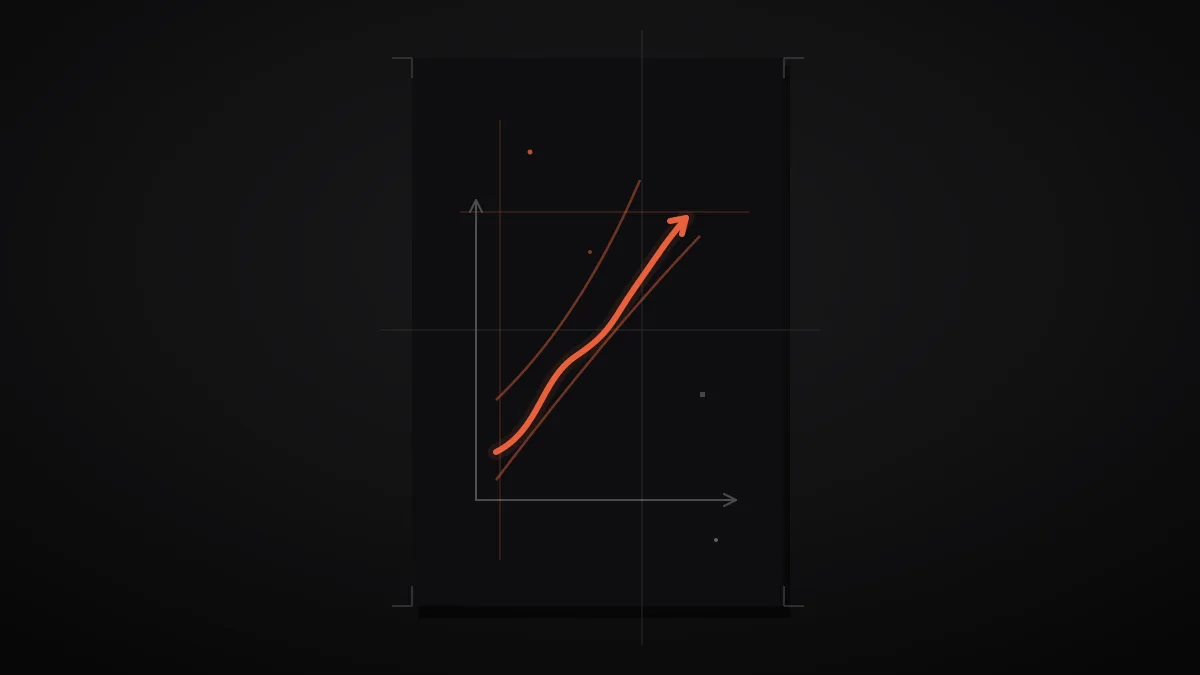
Plot the last condition on axes, challenge vertical and skill horizontal, and you get the flow channel, the model's best-known diagram. When challenge outruns skill, the state degrades into anxiety; when skill outruns challenge, it degrades into boredom; flow lives in the diagonal band between the two. The diagram looks static and is anything but, because practice raises skill, yesterday's challenge drifts toward boredom, and staying in the channel forces you to raise the load. That growth ratchet sits in the model's geometry, and it explains why hobbies with a visible difficulty ladder, climbing or chess, hold people for decades while flat entertainment wears out in weeks. The Milan group of Fausto Massimini and Massimo Carli sharpened the picture with ESM data: flow shows up only when challenge and skill both sit above the participant's personal average. Low challenge with low skill yields apathy, the quadrant where the sampling studies placed a sizable share of television time.
How do you use this when planning work? Later channel models cut the plane finer, with arousal, control, relaxation and worry between the main states, but four fields are enough for a decision. Name your quadrant and you know which knob to turn. Anxiety says the challenge outgrew the skill: shrink the task, or borrow skill from a tool or a second pair of hands. Boredom says the reverse: raise the stakes. Apathy says the task engages nothing and belongs in automation or in the bin. The diagnosis costs one honest question per work block.
The best moments usually occur when a person's body or mind is stretched to its limits in a voluntary effort to accomplish something difficult and worthwhile.Mihaly Csikszentmihalyi, Flow (1990)
Why do three dry conditions produce that phenomenology? Csikszentmihalyi's own explanation runs through attention. Consciousness has a hard processing limit, and he treats disorder inside it — worry, rumination, self-monitoring — as competing traffic on the same narrow channel, which he calls psychic entropy. A task with clear goals, instant feedback and edge-of-ability difficulty takes the entire attention budget, so nothing is left over to run the inner critic or the clock. Loss of self-consciousness is starved self-monitoring, and time distortion is what happens when no process is left to track time. The pleasure arrives mostly afterwards, which is why he insisted flow differs from relaxation.
For engineers I offer an analogy, and this is interpretation: flow resembles a closed control loop, with the goal as the setpoint and feedback as the error signal. A clear goal, fast feedback and the right difficulty help sustain focus, and when one of them is missing, attention starts to wander. That also explains why office knowledge work yields so little flow, which the ESM data has shown for decades. Goals arrive quarterly, so months pass between any single action and the goal; feedback arrives at review time, with latency measured in weeks; difficulty is whatever the ticket queue happens to serve. The office default breaks all three conditions, and then we blame the worker's discipline.
Of the three conditions, feedback speed is the easiest to improve, so that is where a founder can start. Code already has watchers and preview deploys, and the same move ports to the rest of the job. A sales call reviewed from the recording the same afternoon returns a verdict while your moves are still retrievable; reviewed at quarter's end, it returns a grade. A pricing change wired to a live dashboard teaches daily; judged from a monthly report, it teaches twelve times a year. Writing gets its loop from reading aloud, where a sentence fails in your mouth hours before an editor would see it. None of this raises talent. These moves only shorten the path from action to verdict, and the model claims the shortening is what your attention was waiting for.
Hyperfocus: the same state, or a different one?
Clinical descriptions of ADHD contain a state that reads like a flow report. Edward Hallowell and John Ratey, in Driven to Distraction (1994), describe patients who sink into a single activity for hours: total absorption, time blindness, the world gone. Their standing clinical point is that attention in ADHD is wildly variable across contexts, and the variability is the disorder. The same person who cannot hold a routine task for ten minutes can be immovable for nine hours inside a gripping one. Research here is thin: hyperfocus appears in clinics and self-reports far more often than in journals, and it is absent from the DSM-5 diagnostic criteria. Ashinoff and Abu-Akel's 2021 review calls it a forgotten frontier of attention research. The same review hypothesizes that hyperfocus and flow may be one phenomenon described in two literatures, and notes that the definitions of both states are too vague to settle the question. Nobody has yet measured the two side by side with the same method.
Set the two descriptions side by side and the phenomenology nearly coincides: absorption, merged action and awareness, distorted time, a forgotten body. The difference I see concerns the boundaries of the state, entry and exit, and it is an observation from my own work; psychology has not settled this distinction. Csikszentmihalyi's respondents report a sense of control as part of the state: the activity answers to them, including the option to stop. Accounts of hyperfocus in the clinical literature describe the opposite, a state that overrides its owner, skips meals, sails past booked meetings and ends with surfacing at 2 a.m. Then there is entry. A session I planned the night before lands on the task I picked. A session that started by itself lands wherever novelty and urgency streamed fastest, and whether that target serves any of my plans is luck. The essay on predictive coding on this blog proposes a loop-level explanation. Here it is enough to observe that these two boundaries, entry and exit, are the part of a work session you can design.
There is one more difference I see in practice, though the literature does not measure it: the channel. Flow's balance condition drags you up the skill curve, because a mastered challenge stops producing the state. Sessions that start by themselves do not respect the channel and will happily get stuck in repetitive activity far below your skill ceiling, in a grind session, a feed, the forty-first refactor of a settings page, provided the stimulation keeps streaming. A year of flow-shaped work compounds into skill. A year of such sessions can compound into nothing at all, with total honest effort spent.
Csikszentmihalyi saw the edge of this himself and named it the paradox of control. Flow activities feel controllable because they are bounded worlds with knowable rules, and that is part of the draw. He warned, though, that the capacity to produce the state can capture its producer: when someone returns to one activity because only there does order hold, the activity stops serving growth and starts replacing life. He wrote that about chess players and surgeons, and today it reads like a description of a ranked ladder at 3 a.m. The warning sat in the book from the start; the productivity summaries dropped it.
The target-selection failure has an industrial exploiter. A modern game implements Csikszentmihalyi's three conditions better than any job ever has: goals are explicit at every second, feedback returns in milliseconds, and difficulty auto-scales to hold you precisely inside the channel. A social feed does the same without the fiction layer, with an endless goal of one-more-item, feedback in a thumb gesture and zero difficulty. For attention that goes wherever the stimulation is strongest, a game is a trap: the state is real and the output is nothing, and anyone with this wiring knows the specific grief of surfacing from six such hours. The lesson cuts both ways, though. If engineered conditions can capture an ADHD brain that reliably, the same engineering, pointed at chosen work, is the largest lever this model offers.
For my own use I judge a session with two questions, asked after an interruption. Can I name the goal of the last twenty minutes in one sentence? Did I choose this target before it grabbed me? A session that passes had a nameable goal, and the goal was mine; a session that fails has a direction only in hindsight, or the target chose itself. The test costs one interruption, and I check its result against the goal card, a written artifact from before the state that exists partly for this purpose, since it is immune to the stories the state tells about itself. Hence the design consequence, and it differs by brain. A neurotypical reader sets up the flow conditions to summon a state that otherwise visits rarely. An ADHD reader sets up the same conditions to aim and to bound a state that arrives uninvited and overstays. Aiming means choosing the target before anything else absorbs you: the night before, in writing. Bounding means placing the exit outside the state's reach, because deep absorption in a task makes it easy to lose sight of the earlier plan. In practice it means this much: a neurotypical calendar schedules entries, an ADHD calendar schedules exits first.
A founder's block, re-instrumented
Theory earns its keep in a calendar, so here is one block, rebuilt. The setting: a solo founder, morning block 09:00–10:30, a task from the backlog, a CSV import with validation for a client-facing app. The "before" version is how many of my own such blocks ran before the rebuild. The goal reads "work on the importer", which is a direction. Feedback means running the thing manually at the end, ninety minutes away. Difficulty is uncalibrated: the whole feature looms, or some warm-up cleanup beckons. The phone lies face-down on the desk, which is theatre, and nothing marks the exit, because with time blindness the clock in the system tray is furniture. Such a block had two standard endings for me: twenty-five minutes of orbiting the task and then a slide into something louder, or full absorption, after which the block devoured the afternoon along with its two calls and a bank deadline.
| Parameter | Before | After (flow spec) |
|---|---|---|
| Goal | "Work on the importer" — a direction | One testable sentence, written before start: "a malformed row returns a readable error in the UI" |
| Feedback latency | Manual test at the end (~90 min) | Test watcher plus hot reload — a verdict seconds after every save |
| Challenge | Whole feature, or trivial cleanup | A scope you honestly rate a coin flip to finish within the block |
| Entry | Email first, then maybe | Five-minute ritual: yesterday's parking note, the goal card, phone in another room |
| Exit | None | Alarm at 10:25 plus a 10:35 call booked with a human; parking note written before it |
| Tuning rules | None | Stuck 15 min → shrink scope to the nearest passing test. Too easy → add the next requirement from the client's list |
Three notes on the parameters, because the numbers are heuristics from my own practice and nothing more. The coin-flip scope is my own separate heuristic, not part of the model: a task I am sure to finish usually bores me, one I am sure to fail makes me anxious, so I pick a scope in between. The two tuning rules move you back when you drift, and the second adds difficulty only from what the product needs anyway, because making work harder for the state's sake has no justification in client work. The goal card and the test watcher supply two conditions a codebase does not provide by itself: a move-level goal and a verdict within seconds.
On paper the rebuilt block looks like this. At 08:55, the ritual: read yesterday's parking note, write the goal card, carry the phone to the kitchen. At 09:00 the watcher shows green on yesterday's tests and red on today's first one, so the block opens mid-game, with a move already on the board. At 10:25 the alarm fires, at 10:35 the phone rings in the kitchen with the booked call, and the last thirty seconds before it go to tomorrow's parking note. Real mornings depart from this plan at every point except the exit, and that is by design.
The ADHD-specific parameter is the exit, which the neurotypical write-ups leave out. An alarm alone is easy to silence and go back to work, especially with time blindness. The booked human works for one reason: it is the only interrupt with higher priority than the machine, because cancelling on a person costs social pain that the state cannot discount to zero. The parking note leaves tomorrow's next step, written down while it is still obvious. Total setup cost is about ten minutes. The yield comes from my own observation over a few weeks of running such blocks, and it is a rough estimate that I never measured: focus arrives on maybe two mornings in three, and the rebuild moves the base rate, no further. On the mornings it fails, the boring scaffolding argued for in the deep-work essay carries the day instead.
Notice what the rebuild gave each state. Flow got its missing conditions, hyperfocus got its missing brakes, and the same six rows of the table serve at once as an entry protocol and as a containment protocol. That dual use is the whole design.
Where the model fails
The model draws four serious objections, and each changes how you use it.
First, the measurement paradox. Every flow datum is self-report, and the state's own signature makes live reporting impossible: a mind with no spare capacity for self-monitoring cannot fill in a questionnaire, and the beep that samples the episode also ends it. What reaches the dataset is memory at a few seconds' or hours' distance, plus whatever demand effects do to people describing a prized state. Questionnaire instruments built later measure the state minutes after it ends, which softens the beep problem and inherits the memory one. The core evidence is also correlational. Flow reports travel together with performance and satisfaction, and the direction of the arrow was never isolated; work going well may generate the reports, with the state as decoration on top of competence.
Second, moral neutrality, the objection Csikszentmihalyi himself conceded. The conditions specify nothing about the target's worth, and he acknowledged that combat and gambling produce textbook flow. Natasha Dow Schüll's Addiction by Design (2012) shows the concession industrialized. Machine-gambling designers tune explicit goals and instant feedback and calibrate difficulty in micro-steps until players enter what they themselves call the machine zone, and they play to the extinction of their funds. The state that feels like meaning is a value-free amplifier. A founder meets a domesticated version of the same trap, flow on the wrong task, which is procrastination with excellent production values. Absorption alone does not tell you whether the task was worth the time; that question has to be asked separately, cold, before entry.
Third, romanticization. The 1990 book argues a claim about the quality of life, and the productivity industry resold it as an output technology, with flow hours as a metric to maximize. Optimizing for the feeling selects tasks by flow yield, and by that criterion a game beats strategy work every single time. The state is a byproduct of well-structured challenge, and whoever hunts it directly breeds the counterfeit. The state also hides its own cost, because absorption anaesthetises fatigue along with everything else, and whoever has surfaced from a great session unable to form sentences knows what it costs.
Fourth, replication and looseness. Positive psychology's replication record is uneven, and flow research shares the weaknesses. The construct is measured differently across instruments, the channel models re-describe data more than they risk predictions, and the "autotelic personality", a disposition to turn ordinary situations into flow material, was never sharply operationalized. Even the challenge–skill core wobbles at the edges: later ESM work found the balance alone predicts the state poorly when the task means nothing to the doer. The three conditions look necessary and visibly fall short of sufficient, so the defensible core is smaller than the book's reach. Treat the three conditions as sturdy design heuristics with fifty years of consistent observation behind them, and the grand claims about flow as the road to happiness or the engine of peak performance as attractive and unproven.
So run the spec in both directions. Into the block you chose, build the three conditions: a move-level goal, feedback in seconds and difficulty at your edge. Nail the exit down where the state cannot reach it. Then, before you enter, ask the one question flow will never answer from inside: does this target deserve ninety minutes of everything I have?
Sources
- primaryMihaly Csikszentmihalyi, Flow: The Psychology of Optimal Experience (1990) — the synthesis: conditions, autotelic experience, psychic entropy.
- primaryMihaly Csikszentmihalyi, Beyond Boredom and Anxiety (1975) — the first model and the flow channel; studies of climbers, chess players and dancers.
- primaryReed Larson, Mihaly Csikszentmihalyi, "The Experience Sampling Method", New Directions for Methodology of Social and Behavioral Science (1983).
- primaryMihaly Csikszentmihalyi, Judith LeFevre, "Optimal Experience in Work and Leisure", Journal of Personality and Social Psychology (1989) — the paradox of work.
- secondaryFausto Massimini, Massimo Carli, "The systematic assessment of flow in daily experience", in: M. Csikszentmihalyi, I. S. Csikszentmihalyi (eds.), Optimal Experience (1988) — the channel refined against personal averages.
- secondaryEdward M. Hallowell, John J. Ratey, Driven to Distraction (1994, rev. 2011) — the clinical picture of ADHD, including hyperfocus.
- secondaryBrandon K. Ashinoff, Ahmad Abu-Akel, "Hyperfocus: the forgotten frontier of attention research", Psychological Research 85 (2021) — review; the hypothesis that hyperfocus and flow may be one phenomenon.
- secondaryNatasha Dow Schüll, Addiction by Design: Machine Gambling in Las Vegas (2012) — engineered flow conditions and the machine zone.